
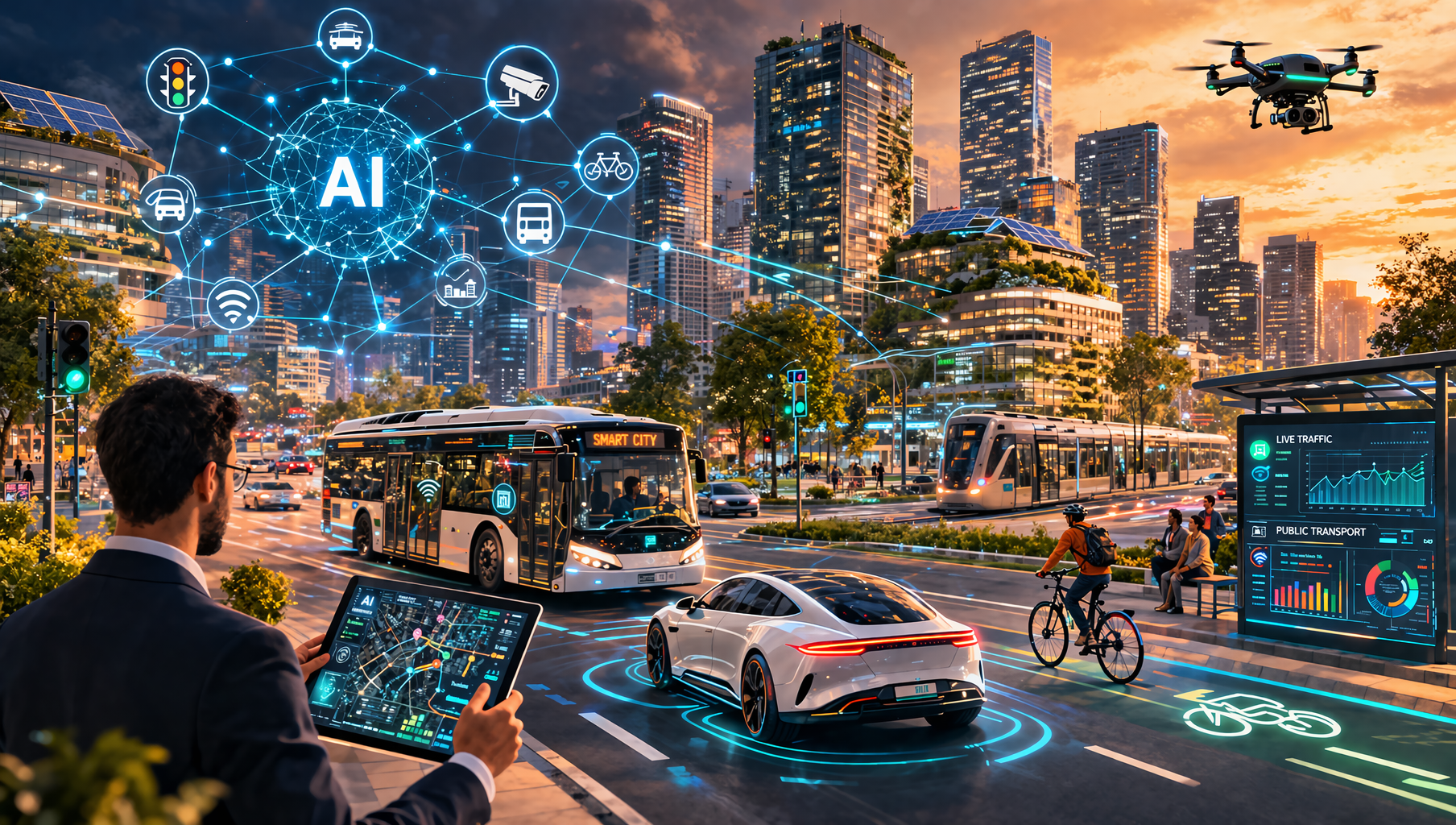
Cities are growing faster than ever, and that growth puts pressure on roads, buses, rail systems, parking, and public spaces. AI in urban mobility is playing an increasingly important role in shaping solutions for these challenges. Urban mobility is no longer just about moving vehicles from one point to another. It is about helping people travel safely, efficiently, and sustainably in increasingly complex city environments.
This is where artificial intelligence is becoming valuable. Smart cities use AI to improve urban mobility by analysing live data, identifying patterns, and supporting faster decisions across transportation systems. Instead of relying only on fixed schedules or manual monitoring, cities can use AI-powered tools to respond to real conditions on the ground.
In practical terms, that means less congestion, better public transport planning, improved road safety, and a more connected mobility experience for residents.
AI Makes Traffic Management More Responsive
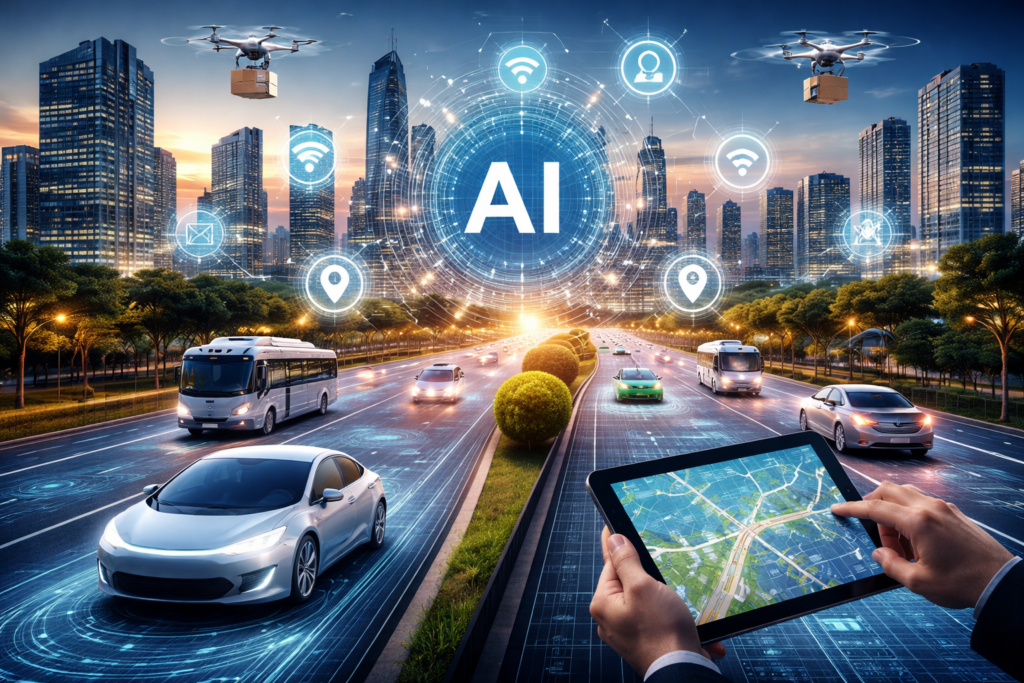
Traffic congestion is one of the biggest mobility problems in modern cities. Traditional signal systems often work on fixed timings, even though traffic conditions change constantly throughout the day. AI improves this by allowing transport systems to respond in real time.
Smart traffic platforms can collect data from road sensors, cameras, and GPS-enabled devices to understand vehicle flow, detect congestion, and adjust traffic signals when needed. This allows junctions to operate more efficiently and helps reduce unnecessary waiting times.
AI can also help identify unusual disruptions such as accidents, road closures, or event-related traffic surges. Instead of waiting for manual intervention, systems can quickly suggest signal changes, route diversions, or control measures that reduce pressure on the road network.
This is closely related to the wider topic already covered on your website in How AI in Transportation Systems Is Transforming Modern Mobility, which explains how AI is changing transport operations more broadly.
https://thesiddique.com/ai-in-transportation-systems/
Smarter Public Transport Planning
Public transport is at the heart of urban mobility, but many systems still struggle with delays, overcrowding, and uneven service planning. AI can improve this by helping transport agencies understand how people actually move through the city.
For example, AI systems can analyse passenger demand, route usage, peak-hour trends, and travel times. With this information, cities can make better decisions about bus frequency, train scheduling, and service allocation. Rather than using the same timetable every day, authorities can respond more intelligently to real demand.
This can improve reliability for passengers while also reducing operational waste. If buses are too frequent on low-demand routes and too limited on crowded ones, the entire network becomes less efficient. AI helps correct these imbalances.
For a site like TheSiddique.com, this topic also connects naturally with your academic and professional interests shown on your About page, where transportation systems and urban mobility are already part of your profile.
https://thesiddique.com/about/
Safer Streets for Pedestrians and Cyclists
Urban mobility is not limited to cars and buses. It also includes people walking, cycling, and using micro-mobility options such as shared bikes and e-scooters. AI can make cities safer for these users by helping identify risk areas and improve street design.
Computer vision systems, for example, can monitor intersections and pedestrian crossings to detect unsafe behaviour patterns. AI can analyse near-miss incidents, identify accident-prone zones, and help transport planners decide where better signage, crossings, or signal timings are needed.
This creates a more evidence-based approach to road safety. Instead of relying only on reported accidents, cities can use AI to detect risks before serious incidents happen. That is especially important in busy urban centres where different travel modes share limited road space.
Parking and Curbside Management
Parking is often overlooked in discussions about urban mobility, but it has a direct effect on congestion. Drivers searching for parking spaces create extra traffic, waste fuel, and add frustration to city travel.
AI helps by analysing parking demand and occupancy in real time. Smart parking systems can guide drivers to available spaces, reduce unnecessary circling, and support better use of limited urban land. In high-demand areas, cities can also use AI to understand curbside activity and manage pickup zones, loading areas, and short-stay parking more effectively.
These improvements may seem small individually, but across an entire city they can significantly improve traffic flow and reduce road pressure.
Supporting Micro-Mobility and Connected Travel
Smart cities are also integrating AI into short-distance mobility services such as bike sharing, e-scooters, and app-based transport. These options are especially important for first-mile and last-mile connections between homes, workplaces, and public transport stations.
AI helps providers understand where demand is highest, when vehicles need repositioning, and which routes are being used most often. This improves service availability and reduces clutter from poorly managed vehicle placement.
More importantly, AI supports the idea of connected travel. A truly smart mobility system is not one where each mode operates separately. It is one where traffic systems, buses, trains, bicycles, and pedestrian infrastructure work together in a coordinated way.
Better Planning for Future Cities
AI is also useful beyond daily operations. It can support long-term mobility planning by helping cities analyse larger datasets and predict future transport needs. Population growth, changing commuting patterns, climate goals, and infrastructure pressures all affect how cities need to plan.
With predictive models, transport authorities can test scenarios, identify future bottlenecks, and make more informed investment decisions. This helps smart cities move away from reactive planning and toward more adaptive, data-informed transport strategies.
The wider discussion around connected, data-driven cities is also reflected in global policy and innovation research. The World Economic Forum regularly explores how technology is influencing the future of cities and mobility.
External link: https://www.weforum.org/
Why This Topic Matters
AI in urban mobility is still a relatively focused niche compared with broad AI topics, which makes it a strong subject for targeted SEO content. It combines smart cities, transportation systems, and artificial intelligence in a way that is practical, timely, and closely aligned with your website’s direction. Your recent post on AI in transportation systems already shows that this topic fits your site naturally.
For readers, it is also highly relevant because it explains how AI is being used in everyday urban life, not just in theory. From traffic lights to bus routes and safer crossings, these technologies are becoming part of how modern cities function.
Conclusion
Smart cities use AI to improve urban mobility by making transportation systems more responsive, efficient, and safer. Whether it is traffic optimisation, public transport planning, road safety analysis, parking management, or support for micro-mobility, AI is helping cities move beyond traditional transport models.
The real value of AI in urban mobility is not just speed. It is the ability to create city transport systems that are smarter, more connected, and better suited to real human needs. As cities continue to evolve, AI will likely become one of the most important tools shaping the future of urban movement.
