
AI predictive maintenance in rail is solving one of the oldest problems in public transport: the train that breaks down mid-journey and throws an entire network into chaos. Sensors, machine learning, and real-time data are changing how railways maintain their fleets and passengers are already feeling the difference.
A single unexpected train failure during morning rush hour can delay tens of thousands of passengers, cascade disruption across an entire network, and cost an operator hundreds of thousands of pounds in a single day. Yet most of these breakdowns are not sudden. They build slowly — a bearing degrading over weeks, a rail crack growing millimetre by millimetre, a brake component wearing beyond its safe threshold. The problem has never been that faults are undetectable. It has been that nobody was watching closely enough to detect them in time.
AI predictive maintenance in rail changes that completely. By embedding sensors throughout trains, tracks, and station infrastructure, and connecting them to machine learning platforms that watch thousands of data streams simultaneously, railways can now see failures coming — and stop them before they happen.
How AI Predictive Maintenance in Rail Actually Works
The foundation of any predictive maintenance system is sensor data. Modern trains are fitted with hundreds of sensors measuring everything from wheel bearing temperature and vibration frequency to brake pad thickness, pantograph pressure, and door mechanism resistance. Track-side sensors measure rail stress, surface wear, and geometry. Overhead line equipment monitors voltage fluctuations that indicate contact wire degradation.
All of this data flows continuously into an AI platform that has been trained on years of historical maintenance records. The system learns what “normal” looks like for every component under every operating condition — at speed, in heat, on curves, under heavy load. When a reading drifts outside its normal range, the AI flags it, assigns a severity level, and generates a maintenance alert with a predicted time-to-failure window.
Crucially, the system does not just detect individual component anomalies. It looks for combinations of signals that together indicate a pattern associated with impending failure — patterns too subtle for human analysts reviewing periodic inspection data to reliably spot.

Real-World Results From Major Rail Networks
The technology is not theoretical. Some of the world’s largest rail operators have been running AI predictive maintenance programmes for years, and the results are documented and significant.
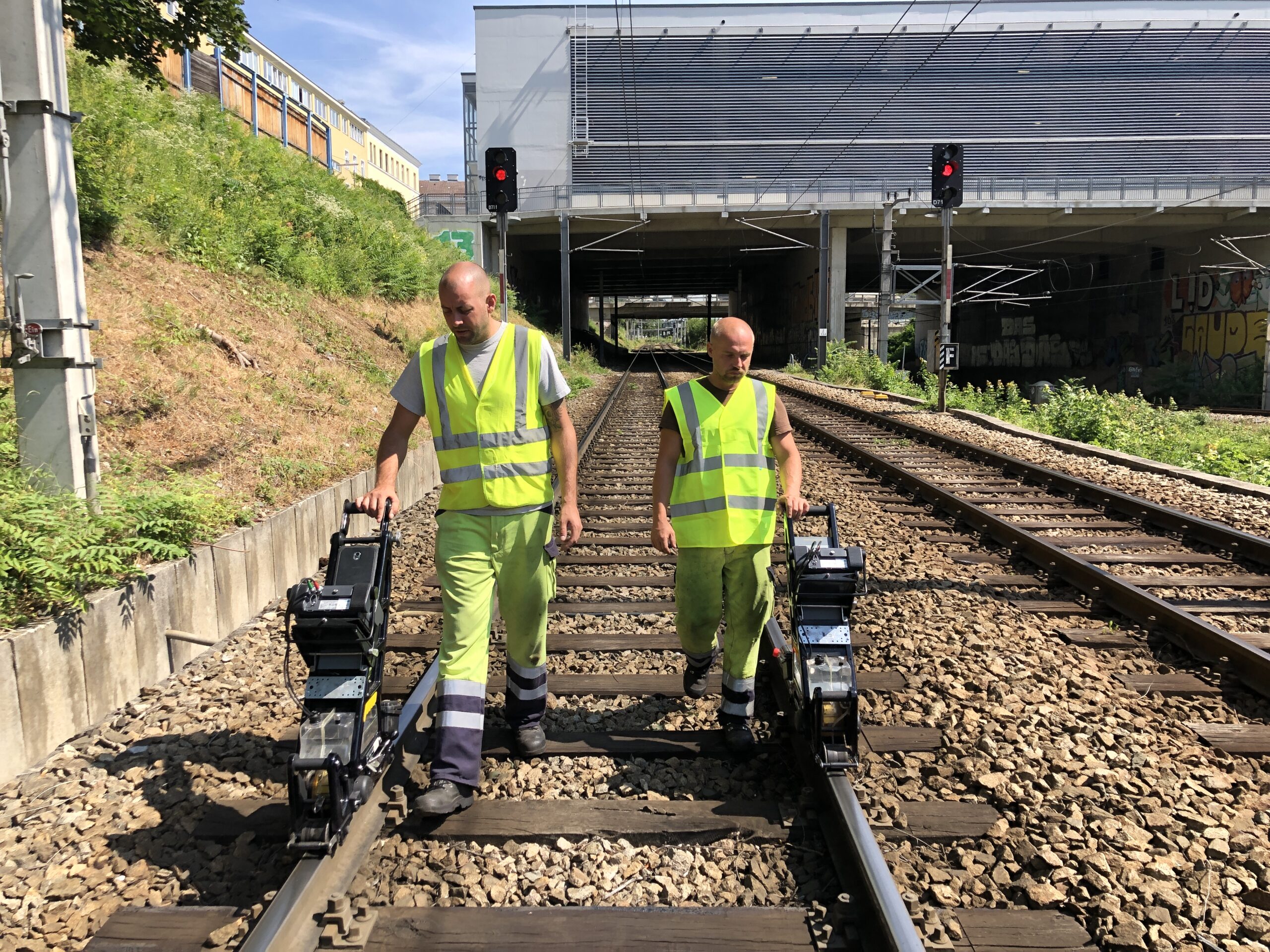
Network Rail in the UK operates a fleet of sensor-equipped track inspection vehicles that scan thousands of miles of rail at line speed, feeding data into AI systems that detect surface cracks, geometry faults, and gauge deviations. Early intervention based on this data has reduced emergency track possessions unplanned closures to carry out urgent repairs which are among the most disruptive events in rail operations.
Deutsche Bahn in Germany has deployed AI predictive maintenance across its ICE high-speed fleet. The system monitors bogie components, wheel sets, and braking systems, scheduling maintenance interventions during planned overnight windows rather than responding to in-service failures. Deutsche Bahn reports significant reductions in unplanned failures per million kilometres operated since the programme launched.
Japan’s Shinkansen bullet train network maintains a punctuality record that is the envy of rail operators worldwide — average delays measured in seconds rather than minutes. Data-driven maintenance has been central to this achievement for decades. The Japanese approach treats the train and its infrastructure as a continuously monitored system, not a collection of components on fixed service schedules.
“We are not fixing trains. We are preventing failures. That is a fundamentally different engineering philosophy — and AI makes it possible at scale.”
— RAIL ENGINEERING RESEARCH, 2025
Beyond Trains: AI Maintenance for Track and Infrastructure
Train-borne sensors capture a great deal of data, but the rail infrastructure itself — tracks, bridges, tunnels, overhead lines, signalling equipment — represents an even larger maintenance challenge. These assets are spread across thousands of miles and deteriorate through a combination of traffic loading, weather, and age.
AI is being applied to infrastructure maintenance through fixed sensor networks, drone-based inspection programmes, and satellite imagery analysis. Computer vision systems can now analyse images of rail surfaces and identify cracks, corrosion, and ballast degradation with greater consistency and speed than visual inspection teams. Acoustic monitoring systems listen for the characteristic sound signatures of rail defects as trains pass over them.

What This Means for Passengers and Operators
For passengers, the most visible benefit of AI predictive maintenance in rail is straightforward: fewer unplanned delays caused by mechanical failures. A train taken out of service for a planned overnight bearing replacement causes no disruption at all. The same bearing failing at speed between stations causes hours of delay for every train behind it on the network.
For operators, the financial case is compelling. Emergency callouts, tow-out operations, compensation payments, and reputational damage from high profile failures all carry significant costs. Predictive maintenance reduces all of these. Equally important, it extends the working life of expensive rolling stock by ensuring components are replaced at the optimal point not too early, not too late.
The railways that are winning on punctuality, reliability, and passenger satisfaction in 2026 are not necessarily the ones with the newest trains. They are the ones that know their assets best — and AI is the tool that makes that depth of knowledge possible at scale.
Frequently Asked Questions
AI predictive maintenance in rail uses sensors fitted to trains, tracks, and infrastructure to collect real-time data on vibration, temperature, wear, and stress. AI algorithms analyse this data continuously and flag components showing signs of impending failure allowing maintenance teams to intervene before a breakdown occurs, rather than waiting for something to go wrong.
Several major rail networks have deployed AI predictive maintenance. Network Rail in the UK uses sensor-equipped inspection vehicles and AI analysis to detect rail defects early. Deutsche Bahn in Germany runs an AI-powered programme across its ICE high-speed fleet. Japan’s Shinkansen bullet train network has used data-driven maintenance for years, contributing to its world-class punctuality record.
raditional maintenance is scheduled at fixed intervals, meaning some parts are serviced unnecessarily while others can fail unexpectedly mid-service. AI predictive maintenance replaces this with condition based servicing components are only taken out of service when sensor data indicates they need attention. This eliminates most unexpected breakdowns, which are the single largest cause of unplanned rail delays.
